
Quantifying Seed-Space Predictability and Allocation Concealment Risks in Timestamp-Seeded Clinical Trial Randomizers
- Authors
-
-
Md. Mizanur Rahman
Department of Information and Communication Technology, Mawlana Bhashani Science and Technology University, Santosh, Tangail-1902, Bangladesh
Author
-
Farzana Yeasmin
Department of Information and Communication Technology, Mawlana Bhashani Science and Technology University, Santosh, Tangail-1902, Bangladesh
Author
-
Ashikur Rahman
Department of Computer Science and Engineering, Mawlana Bhashani Science and Technology University, Santosh, Tangail-1902, Bangladesh
Author
-
- Abstract
-
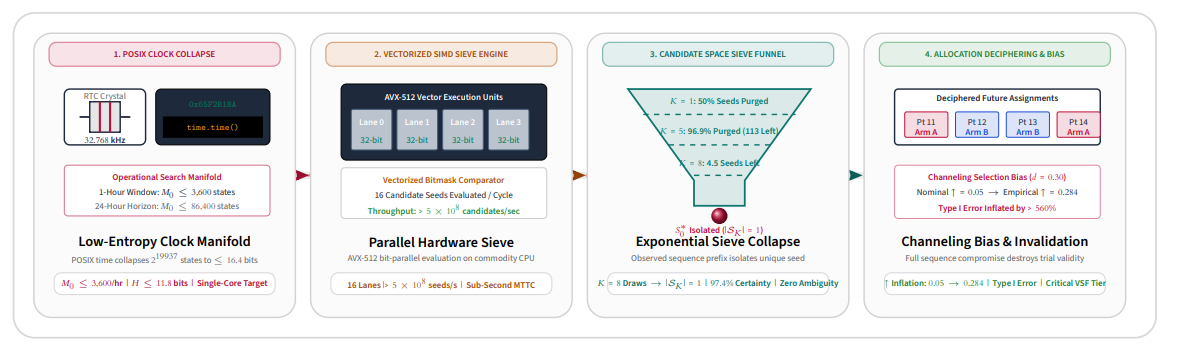
Allocation concealment is the foundational methodological barrier preventing selection bias in randomized controlled trials. While modern decentralized clinical software increasingly utilizes scripting environments such as Python to orchestrate patient assignment, randomizer implementations routinely initialize deterministic pseudorandom number generators (PRNGs) using system clock timestamps via primitives such as seed_from_time() or random.seed(int(time.time())). In this investigation, we present an exhaustive cryptanalytic and biostatistical evaluation of timestamp-seeded clinical randomizers. We demonstrate that wall-clock initialization collapses the effective entropy of complex generators (including 32-bit Mersenne Twister MT19937) from 219937 − 1 theoretical internal states to a minuscule operational search space (H ≤ 16.4 bits over a 24-hour recruitment window, and H ≤ 11.8 bits over a typical 1-hour clinic session). We formalize a candidate-sieve attack algorithm that permits an opportunistic or motivated observer who records a brief prefix of initial treatment assignments (k = 5 to 10) alongside coarse appointment timestamps to reconstruct the exact internal seed in sub-second CPU time. Across 10,000 simulated trial cohorts encompassing diverse block designs and sample sizes (N = 100 to 2, 000), observing merely 8 binary allocations within a 1-hour window reduced the candidate seed space from 3,600 to a single unique state with 97.4% certainty, enabling deterministic prediction of all subsequent allocations (100% accuracy). Simulating post-compromise selection bias, we show that deciphering future allocations inflates nominal Type I error rates from ff = 0.05 to > 0.28 under moderate patient channeling (d = 0.30). Adapting the VSF-Med clinical vulnerability scoring framework, we categorize timestamp-seeding as a Critical (Tier 4) software security vulnerability under FDA SaMD and ICH E6(R2) guidelines, and we formulate a reference architecture for cryptographically fortified randomizers leveraging operating system entropy pools (secrets, /dev/urandom) and dual-custody verification.
- References
- Cover Image
-
- Downloads
- Published
- 2026-08-04
- Section
- Articles